

What is Emotional Infrastructure™?
Most leadership development focuses on what leaders should do. But when pressure rises, leadership is no longer driven by techniques. It is driven by internal structure.
The internal systems that determine how you lead under pressure.
Emotional infrastructure refers to the internal systems that determine how leaders process stress, regulate their responses, interpret difficult experiences, and maintain clarity under pressure.
In high-stakes environments, these internal systems shape everything: how quickly leaders become reactive, how conflict is processed or carried forward, how responsibility is absorbed or managed, how decisions are made when emotions run high.
By integrating principles from leadership psychology, neuroscience, and behavioral science, Leaders on Edge™ helps leaders strengthen the internal architecture that supports sustainable leadership.
Because influence is not built only through skill. It is built through the structure a leader operates from.
The Emotional Infrastructure Model™
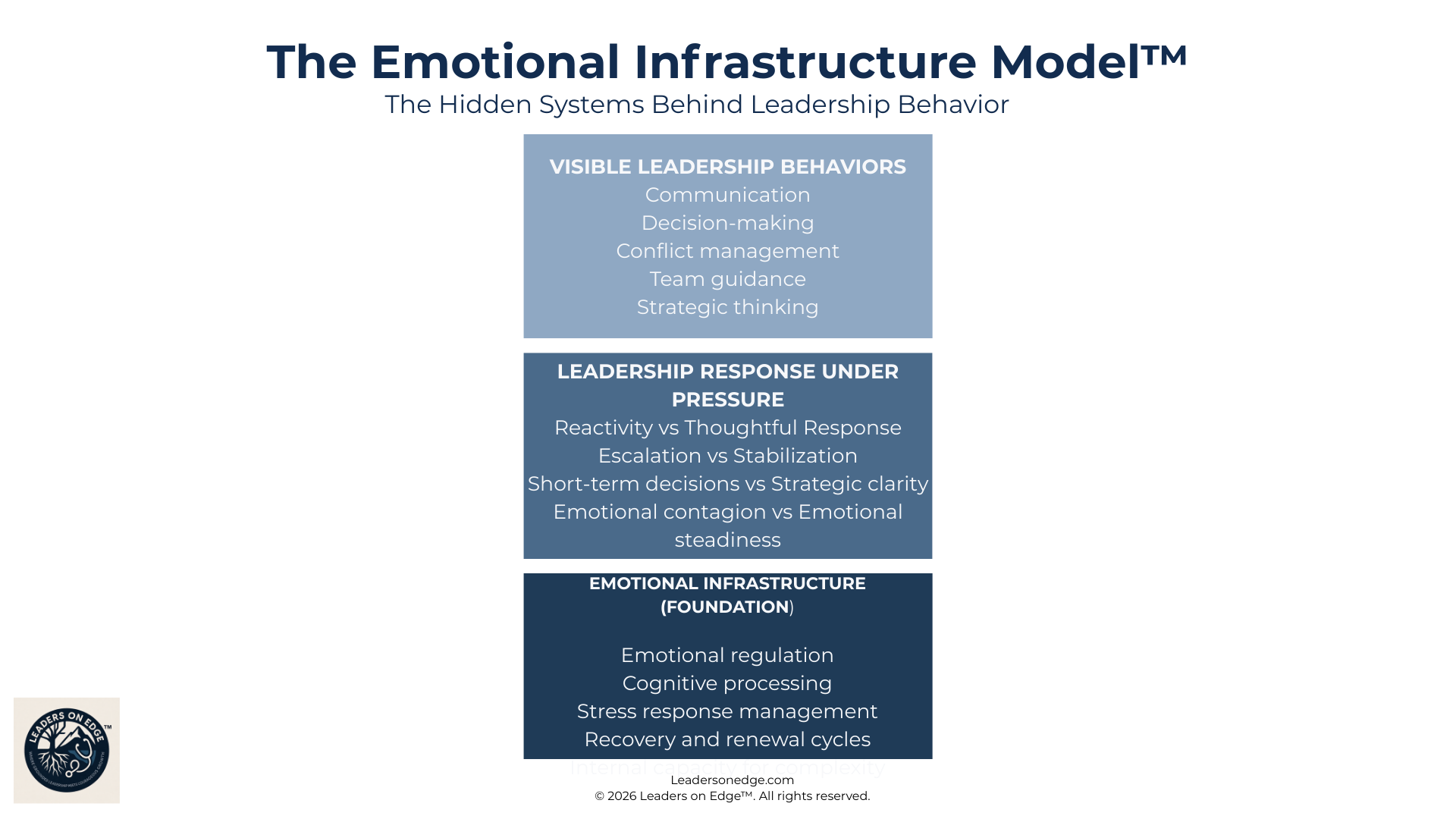
The Emotional Infrastructure Model™ illustrates the hidden systems that shape leadership behavior. While leadership is often judged by visible actions — communication, decision-making, team guidance — those behaviors are driven by deeper internal systems. Emotional regulation, cognitive processing, stress response management, and recovery capacity determine how leaders respond when pressure rises.